THREATS ARE INFINITE YOUR SOFTWARE'S JOB IS NOT
Introducing Program Behavior Intelligence™ (PBI™)
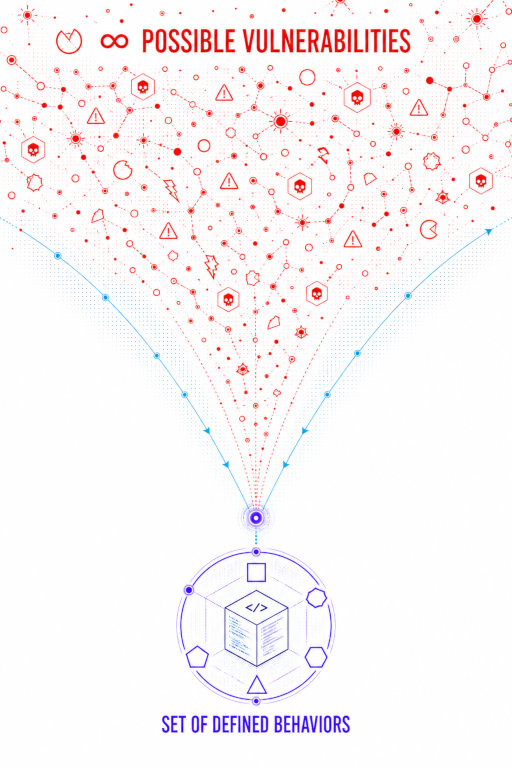
Every application in use today already contains the flaw that will allow it to be compromised.
Every new line of code written carries the same certainty, not because we have given up on secure by design,
but because no one can list every way a program can be made to misbehave.
That limit was proved mathematically in 1953, and it has not moved since.
PBI solves the problem from the other end: it stops your application doing anything it has not been approved to do.
Problem
Application security assumes you can find and fix a flaw before someone exploits it. AI has closed the gap between those two moments, and the assumption no longer holds.
Insight
The limit is what security aims at. The list of possible flaws is infinite, and you cannot model the infinite, so coverage is never complete.
Solution
Software is built to do a specific, known set of things. That set is finite, so we can model it, using the tests you already run. If we can model it, we can enforce it. Anything outside the model never executes.
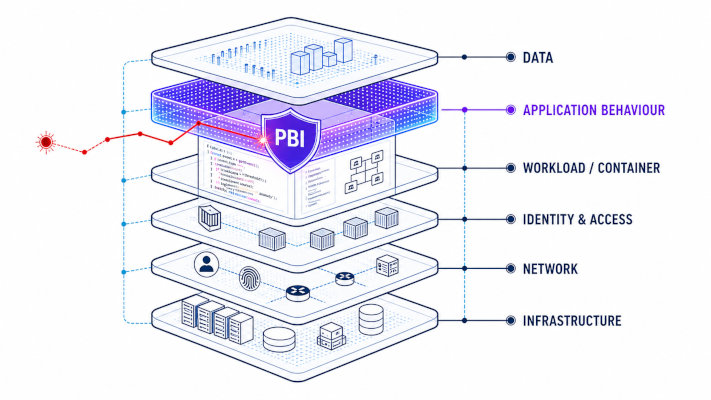
A new protective layer
PBI does not replace existing protection. It adds a complementary layer operating at the application itself.
It works across both staging and production environments, supporting runtime security and DevSecOps teams alike.
Build, explain, enforce
Three stages, one model. Nothing is enforced until your team has approved it.
Build
PBI Explainer™ builds a schema of the application's intended behavior by watching it run through the tests you already have. No new instrumentation; no need to access source code.
Explain
That schema becomes a clear account of what the application actually does, readable by people and by AI. Your team reviews, corrects and approves it.
Enforce
At runtime, PBI Enforcement™ allows only the behavior the schema defines. Anything outside it is stopped before it executes. No guesswork, no alerts to chase.
How PBI products create value
Prevention is the core of PBI. Building the model to make that possible delivers three further benefits along the way.
Runtime prevention
PBI enforces every action against the approved behavioral model before it executes, protecting against both known and unknown threats.
Software supply chain assurance
PBI shows how software and third-party components actually behave, identifying unexpected functionality or compromise that conventional supply-chain controls miss.
Better test coverage
PBI maps the behaviors exercised during testing, revealing untested execution paths, so you can close coverage gaps before deployment.
One approach, three products
Program Behavior Intelligence™ is a systematic approach to application security, delivered as three products. Each models what software is built to do and enforces that model, whether the software serves your users or acts for an AI agent.
PBI Explainer™
Builds and verifies the model from the tests you already run. Provides assurance across the software supply chain and supports DevSecOps.
PBI Enforcement™
Enforces that model at runtime. Prevents unapproved behavior from executing, including both known and unknown attac, and supports the SOC.
PBI Agentic™
Extends enforcement to where AI agents act. Actions outside the model never run, and consequential ones wait for an independent sign-off.