DEFINE EXACTLY WHAT AI IS ALLOWED TO DO ENFORCE THAT AT RUNTIME
Introducing PBI Agentic™
The industry is trying to make AI agents safe by making them more trustworthy: better guardrails, better alignment, better judgment of intent. PBI Agentic takes the opposite approach. We do not model what an agent thinks, and we make no claim to. We bound what it is able to do.
Problem
Agents are nondeterministic by design. The same prompt can produce different reasoning and different actions on different runs, and no amount of monitoring will make that predictable.
Insight
The output is not what hurts you. The consequence is: the tool called, the file written, the payment initiated, the code shipped. Those consequences do not happen inside the model. They happen in the ordinary, deterministic software around it, and that software can be modeled.
Solution
Program Behavior Intelligence™ (PBI) models what the software around the agent is built to do, from the tests you already run, and enforces it in the environment the agent itself operates in. The agent stays unpredictable, but its unpredictability is confined to a space you defined. Its blast radius is exactly the set of actions you permitted, and not one thing more.
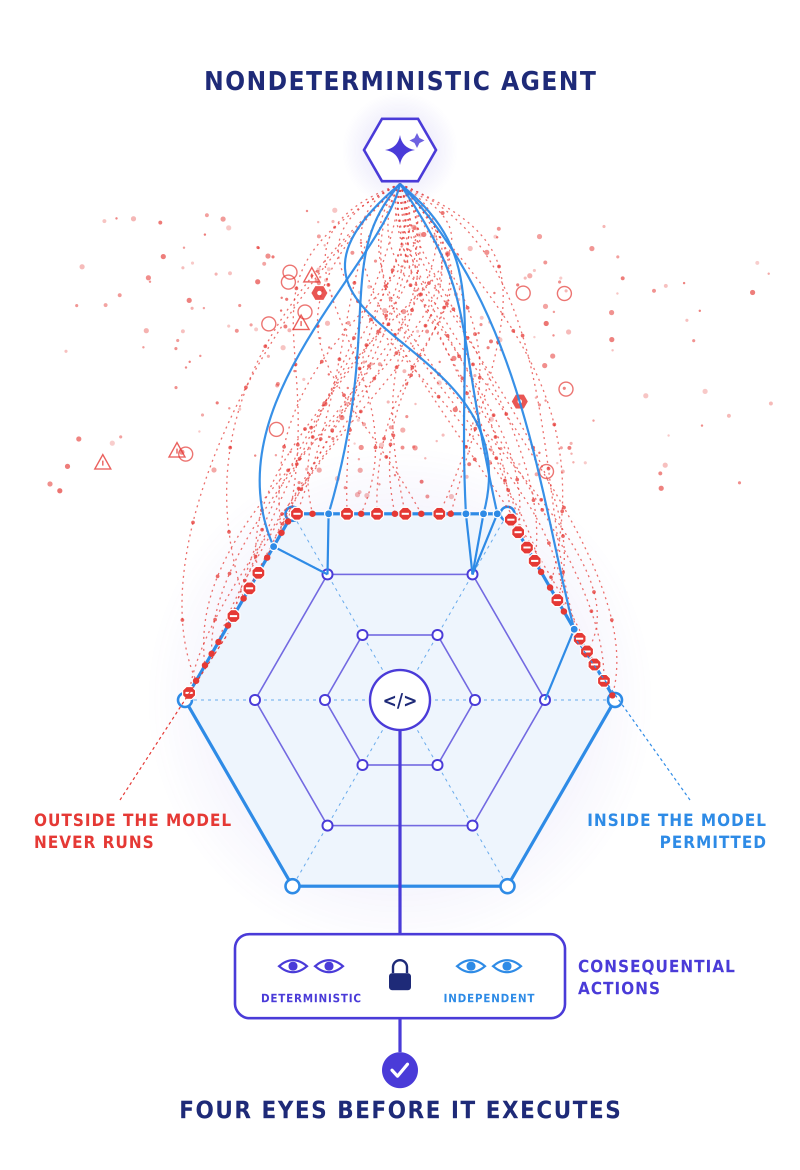
Two questions at the point of execution
Is this action in the model?
If not, it never runs, whatever the agent decided and however it reasoned its way there. This is the same deterministic enforcement as PBI Enforcement™, extended to the agent's own environment.
It is in the model. Should it proceed?
Some permitted actions are also consequential and hard to undo: moving money, deleting data, deploying to production, granting access. These do not proceed on one party's authority alone.
Four eyes, enforced by construction
Separation of duties is one of the oldest controls in security: no single party authorizes a consequential action alone.
PBI Agentic™ applies that same control where agents act. A consequential action does not execute until a second, independent authorization is present. Because the gate is enforcement rather than a request, the agent cannot route around it or be talked past it.
The deterministic layer is one set of eyes, and it is never persuaded by a clever prompt. What supplies the second is yours to define: another governed system, a separate service, or a person where your policy requires one.
It governs actions, not agents. A person triggering the same operation meets the same gate.
What it does not do
It does not judge wisdom
Bounding an action space says what may happen, not whether a permitted action was a good idea. That is precisely why the consequential ones are gated.
It does not read the agent's mind
There is no scoring of intent and no attempt to predict the next output. The model describes the software, not the agent.
It depends on your tests
The model is built from the tests you run against the agent's tools and harness. Where coverage is thin, PBI names the missing test cases rather than guessing.
We are looking for design partners
The architecture is built. We are now looking for a small number of organizations to deploy it with, and to help shape what it becomes.
Who we are looking for
Teams running AI agents in production or close to it, where agents can take consequential actions
What you get
Early deployment alongside our engineers, direct influence over the product, and a deterministic answer to the question your board will ask about your agents.